
Short answer: who is this Pionex guide for?
This guide is for traders who are comparing exchanges because they actually plan to trade: grid-bot users, DCA builders, tokenized-stock explorers, high-frequency spot traders, and people who want a fee-cashback path instead of only a welcome-bonus headline. If you only want to click a code and hope for a payout, this page will feel stricter than most referral pages. That is intentional. The users who usually keep value from a trading platform are the users who understand fees, risk, bot settings, liquidity, jurisdiction limits and how to verify the referral code before depositing.
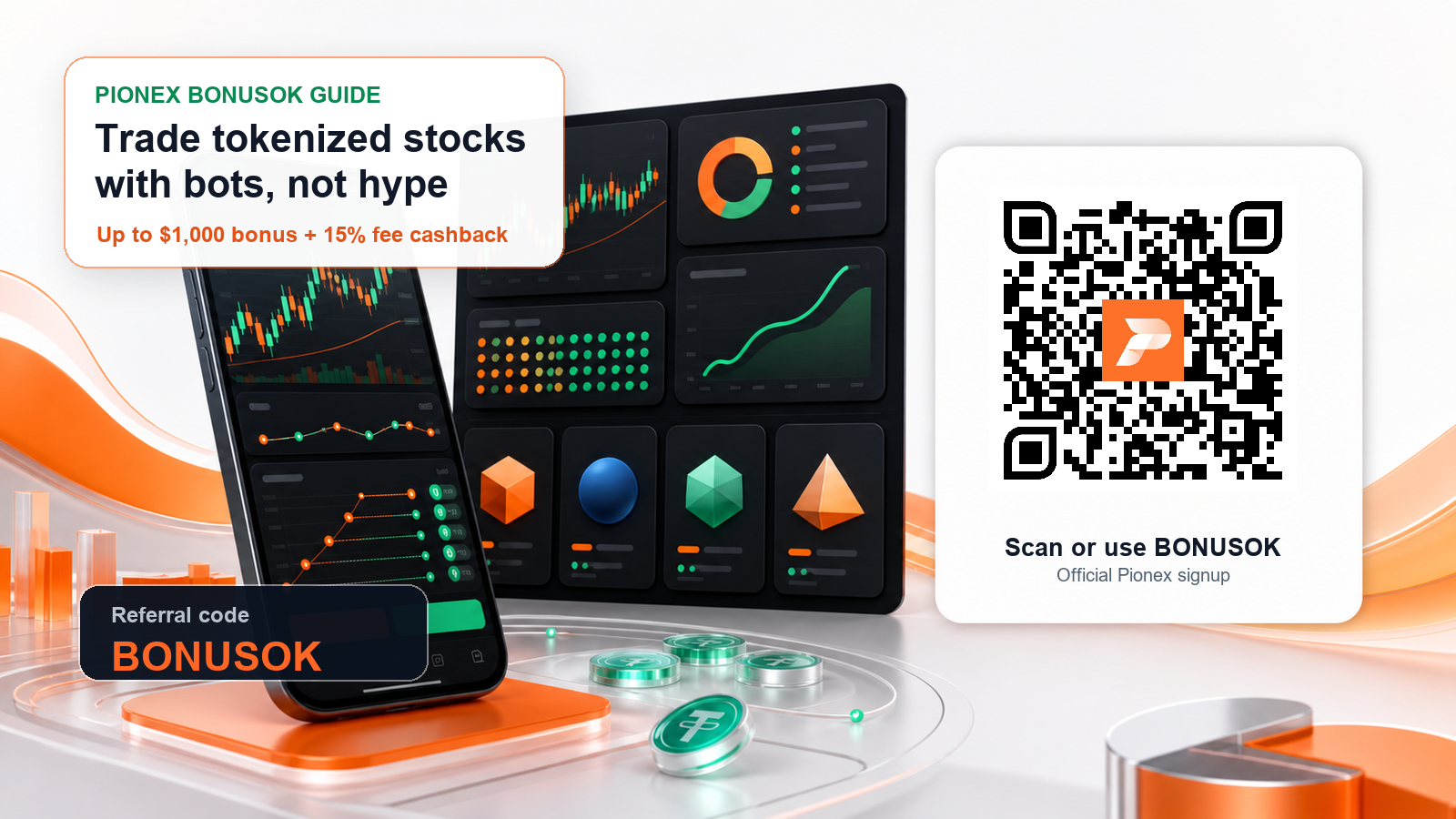
The referral code is BONUSOK. The official campaign link used on this page is https://partner.pionex.com/p/BONUSOK. The offer we track for this campaign is bonuses up to $1,000 plus 15% fee cashback, subject to Pionex eligibility and campaign rules. Use the code before you fund the account, then check that it is applied in the relevant Pionex registration or referral screen. If the account is already created, review the section below about referral-code refill before assuming the code is lost.
Pionex is interesting because its core pitch is not only a spot exchange. Its main conversion hook is built-in automation: Grid Bot, DCA Bot, Futures Grid and other bot-style workflows that make systematic trading easier to run. The newer product angle is tokenized-stock access through xStocks and related tokenized-stock documentation. That does not mean every product is available to every user, every region, or every risk profile. It means Pionex is a better fit for traders who want to test rules-based strategies and who are willing to monitor them rather than treat bots as passive income machines.
The pre-signup checklist for BONUSOK
Before opening the account, do these checks in order. First, open the official referral link, not a copied link from a random comment thread. Second, confirm that the code shown during signup is BONUSOK or that the referral path clearly corresponds to the BONUSOK campaign. Third, read the actual campaign conditions inside Pionex after login. Bonus tasks often depend on timing, deposit amount, trading volume, product type, account status and geographic eligibility. Fourth, do not deposit more than you planned just to unlock a reward tier. The reward is secondary; the trading plan is primary.
Fifth, decide which Pionex product you are signing up for. A trader who wants spot grid automation should start with small spot positions and conservative grid spacing. A trader who wants DCA should care about schedule, asset allocation, quote currency and downside tolerance. A trader who wants Futures Grid should understand margin, leverage, funding and liquidation before they even think about a bonus. A trader who wants xStocks should understand that tokenized stocks can carry additional market, issuer, liquidity, availability and trading-hour risks compared with ordinary crypto spot pairs.
Finally, take screenshots of the code and the campaign terms at registration. This is not paranoia; it is basic trading admin. If cashback, bonus tasks or referral attribution later look wrong, a dated screenshot helps you check what happened. The goal is to enter Pionex with a documented plan, not to argue with support after an avoidable mistake.
Newer Pionex hook: referral-code refill after signup
A useful recent support item from Pionex is the referral-code refill flow. Pionex describes a way to add a referral code after account creation when the account is still inside a specific time window and has not completed certain actions. This matters because many traders create an account quickly, skip the invite field, and only later realize that the code should have been attached before trading. A recovery path is not a reason to be careless, but it is a good search-intent angle: people often look for "Pionex referral code after signup", "Pionex invite code missed", or "can I add Pionex code later?"
Based on the current Pionex support article, the refill option is designed for accounts registered within the last 14 days and only if KYC verification has not been completed or deposit actions have not happened. Users must check the exact current rule in Pionex because platform policies can change. The practical advice is simple: enter BONUSOK during signup if possible; use refill only as a backup; and if KYC or deposit has already happened, do not assume support can retroactively apply the code.
This is also why this Vercel page leads with verification steps instead of only a big button. A referral material that helps users avoid attribution mistakes can attract more qualified traders than a thin coupon post. It answers a real operational question and then routes the user to the official campaign path.
Why active bot traders may care about Pionex
The main active-trader reason to test Pionex is that the bot layer is built into the exchange experience. You are not only connecting an external bot to an API and hoping your permissions, latency, pair mapping and order logic stay clean. For many users, a built-in bot interface is easier to start with. That does not remove risk. It simply reduces some setup friction and makes it easier to compare a bot's configuration with the market you are trading.
Grid Bot is usually the first Pionex product people research. A grid bot places buy and sell orders across a price range. In a sideways or choppy market, the bot can capture repeated movement. In a strong one-way trend, the bot can become uncomfortable: it may accumulate the asset while price falls, sell too early while price rises, or sit outside its configured range. The settings that matter are the upper price, lower price, number of grids, investment size, grid spacing, asset pair, stop conditions and the trader's willingness to rebalance when market structure changes.
Pionex's 2026 grid-bot educational materials place useful emphasis on parameters rather than hype. That is the right frame. A grid bot is not a profit button. It is a rules engine. If the rule is poorly chosen, automation only executes the poor rule faster and more consistently. If the rule is conservative, sized properly and monitored, the bot can help a trader stay systematic instead of revenge-trading every candle.
DCA Bot is a different mental model. Instead of trying to trade a range, it schedules recurring buys or structured entries. DCA can suit users who want exposure over time, but it still has risk: the asset can keep falling, your cash allocation can be exhausted, and the bot can keep buying into a thesis that has changed. The right DCA question is not "how do I automate buys?" It is "what position size, time horizon, invalidation point and asset quality make this automation sensible?"
Futures Grid requires the most caution. Futures automation introduces leverage, margin pressure, funding costs and liquidation risk. A user can be correct about short-term volatility and still lose because the position size or leverage is wrong. If you use Pionex Futures Grid, start with the smallest size you can learn from, read the margin mode carefully, and know exactly where liquidation, stop loss and bot shutdown conditions sit before the bot goes live.
xStocks and tokenized stocks: useful hook, not a shortcut
Pionex has published guides and help-center materials around tokenized stocks and xStocks, including trading tokenized stocks with USDT and later updates around certain tokenized-stock trading modes. This is a strong English-language acquisition hook because it reaches a different user than a basic referral-code search. A tokenized-stock trader is often curious about 24/7 market access, crypto collateral, USDT settlement, and the ability to keep more activity inside one trading account.
However, tokenized-stock products deserve careful wording. They are not the same as directly holding traditional shares in a standard brokerage account. Availability, trading hours, underlying issuer mechanics, fees, liquidity, corporate-action treatment, redemption rights, legal classification and regional access can differ. The responsible way to present xStocks is to say: this may be useful for eligible users who understand the product wrapper, but it should be checked against the latest Pionex documentation and local rules before trading.
For referral acquisition, xStocks pairs well with BONUSOK because it gives the page a product-specific reason to exist. Search engines and AI answer engines are less impressed by yet another "Pionex code" page. A page that explains how an active trader might combine referral-code verification, grid-bot risk controls, DCA discipline and tokenized-stock product checks has a better chance of attracting users who actually plan to trade after signup.
How to use BONUSOK without letting the bonus drive bad trading
The safest way to treat the BONUSOK campaign is as a fee and onboarding improvement, not as a reason to trade more aggressively. If you were already going to test Pionex, a valid code can improve your economics. If you were not going to trade, a conditional bonus should not create a trade. This distinction matters because fee cashback and bonus tasks can create a subtle trap: users increase volume to hit a requirement, then pay spread, slippage, funding, liquidation risk or opportunity cost that is larger than the reward.
Use this sequence. Decide your maximum test budget before opening the account. Select one learning objective: run a spot grid with small size, test a DCA schedule, compare bot controls, or study xStocks documentation. Apply BONUSOK. Verify eligibility. Deposit only the planned amount. Run the smallest version of the strategy that can teach you something. Review fees and realized/unrealized PnL after a set number of days. Only then decide whether the account deserves more capital.
This approach may reduce the number of impulsive clicks, but it improves referral quality. It attracts users who are more likely to finish KYC, make a deliberate deposit, place real trades and stay active beyond the first campaign task.
Risk warning and eligibility caution
Do not use VPNs, false residency details, borrowed identities or other bypass tactics to access restricted products. If a product is unavailable in your region, that is a stop sign, not an optimization problem. A good referral funnel should not push users into accounts they cannot lawfully or safely maintain.
Also remember that official source links on this page are for research. The commercial CTA is the dedicated BONUSOK campaign link. Source links are kept clean so readers can verify claims without being forced through a referral path for every citation.
Product fit table
| Pionex product angle | Best-fit trader | Main risk to check first |
|---|---|---|
| Grid Bot | Range traders who want systematic buy/sell orders. | Price leaves the range, grid spacing is too tight, or position size is too large. |
| DCA Bot | Users building gradual exposure with fixed rules. | The thesis changes while automation keeps buying. |
| Futures Grid | Experienced users who understand leverage, margin and liquidation. | Liquidation, funding, overleverage and fast volatility spikes. |
| xStocks / tokenized stocks | Eligible users exploring tokenized market access with USDT. | Product structure, region limits, liquidity, issuer and trading-hour differences. |
Sources checked for this page
Bottom line
Pionex is most compelling when the user has a real trading workflow: spot grid automation, disciplined DCA, carefully sized futures-grid experiments, or research into xStocks and tokenized-stock access. The BONUSOK code can improve the onboarding economics for eligible users, but it should not be the reason to take extra risk. Treat the referral code as an account setup step, verify it before funding, then trade only the plan you would still accept if there were no bonus at all.